Objective insights on attention, activity and impulsivity
At ADHD360, we are dedicated to improving the lives of our patients through advanced and personalised care.
We recognise that ADHD is a complex condition that presents differently across individuals, based on factors such as age and sex assigned at birth.
That is why we have incorporated QbCheck, an evidence-based test designed to enhance the ADHD assessment and ADHD treatment process.
Using motion tracking systems and computerised tasks, QbCheck provides invaluable data on the core ADHD symptoms: hyperactivity, impulsivity and inattention. It is an effective tool for diagnosing ADHD in both children and adults (6-60 years).
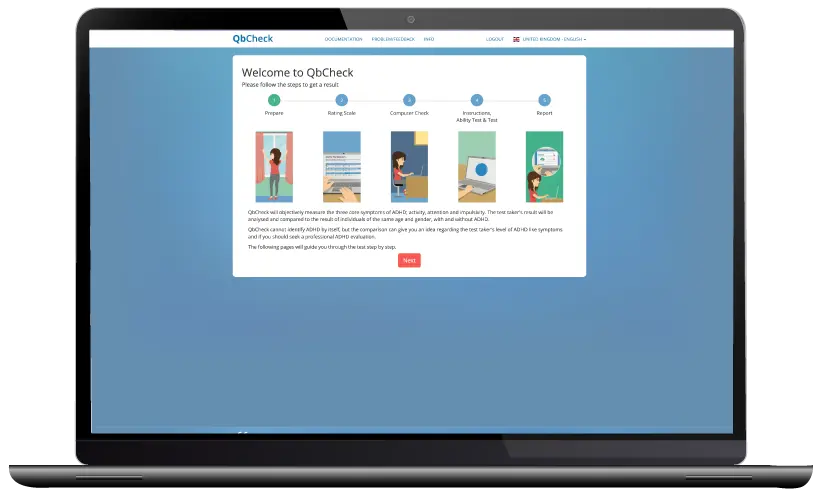
As a computer-based screening tool, the test can be carried out from the comfort of your own home. QbCheck is a user-friendly assessment tool that offers convenience, accuracy, and valuable feedback to support your ADHD diagnosis and treatment journey.
Your QbCheck results are compared with individuals of the same age and gender (biological sex), who have a clinical diagnosis of ADHD and those who do not.
QbCheck is not a standalone test for ADHD, it is designed to enhance the assessment process by combining objective data and subjective information. By measuring your activity level, ability to concentrate and impulse control, we can obtain a more comprehensive evaluation of ADHD symptoms, enabling us to deliver personalised treatment plans that cater to the unique needs of each individual.

Follow up QbChecks will help us to evaluate the effectiveness of your ADHD treatment as you progress through your personalised treatment plan. This supports our clinical decisions and ensures you are receiving the most appropriate care.
Widely recognised and well-documented, QbCheck is an ADHD assessment tool. The test has obtained the CE Mark and has been registered by the European Medicines Agency (EMA) and the Food and Drug Administration (FDA). Backed by more than 30 clinical publications, QbCheck redefines ADHD assessments, leading to more informed diagnosis and treatment decisions.
During your patient journey, you will be asked to complete a QbCheck as part of your pre-assessment to-do list and throughout your treatment journey.You can find out more about the patient journey here.
To be eligible for a QbCheck you must:
you will be provided with step-by-step instructions. To get the most from your QbCheck, we recommend that you check out our guides "Preparing for your QbCheck" and "What to expect from your QbCheck" below.
For a successful testing experience, it's important that you allocate 30-40 minutes for the test and ensure the following:
Device. Use a laptop, computer, or MacBook with a webcam. QbCheck does not work on smartphones, iPads, Chromebooks, or Surfaces.
Power connection. Plug your device into a power outlet to avoid running the test in battery mode. Ensure power settings are set to 'High Performance'.
Internet connection and browsers. Ensure a stable internet connection. Use Google Chrome or Edge (for Windows 10) browsers, make sure they are running on the latest version.
Lighting Considerations. Avoid direct sunlight and bright lighting behind you. Position the webcam to minimise glare from windows, mirrors, lamps or other bright objects.
Appropriate Seating. Use sturdy seating and avoid swivelling, moving, or reclining chairs or sofas.
Close other programs. Optimise device performance and minimise distractions by closing all other browsers and programs.
Quiet Environment. Find a calm and quiet space to give your full attention to the test. Turn off or put your phone on "do not disturb".
Clear Facial Visibility. Ensure your face is fully visible and uncovered. Headwear and facial decorations may cause issues, glasses can be worn.
Since 2002, Qbtech has been dedicated to an ADHD assessment approach that prioritises technology. By combining both subjective and objective data, Qbtech strive to help clinicians provide a more comprehensive and accurate assessment of individuals with ADHD.
Qbtech recognised the limitations of relying solely on subjective data from interviews with parents, patients, and teachers for an accurate diagnosis. This realisation ignited their determination to revolutionise the diagnostic process and introduce a more comprehensive approach.
QbCheck results will help our clinicians determine how you performed compared to your peers and, when used together with other clinically relevant information, if you have ADHD or not. When used as follow up test, QbCheck will help to evaluate the effectiveness of your ADHD treatment.
QbCheck is easy to perform and will be done on your own computer at home. The test takes 15 or 20 minutes, and you will receive step-by-step instructions on how to prepare. There is, however, no such thing as “pass or fail” for this type of test and the test is not dependent on language, reading or mathematical skills.
QbCheck uses motion tracking systems and computerised tasks to measure your activity level, ability to concentrate and impulse control. As a result, the tests provide data on all core signs of ADHD: Hyperactivity, impulsivity, and inattention. Your test results are compared with individuals of the same age and gender (biological sex), who have a clinical diagnosis of ADHD and those who do not.
This is particularly important given that ADHD can look very different in boys and girls as well as in women and men.
QbCheck is well documented, widely used, CE-marked and FDA Cleared. The test also shares a strong evidence base with QbTest, which is used within the NHS and positively appraised by the National Institute for Health and Care Excellence (NICE).