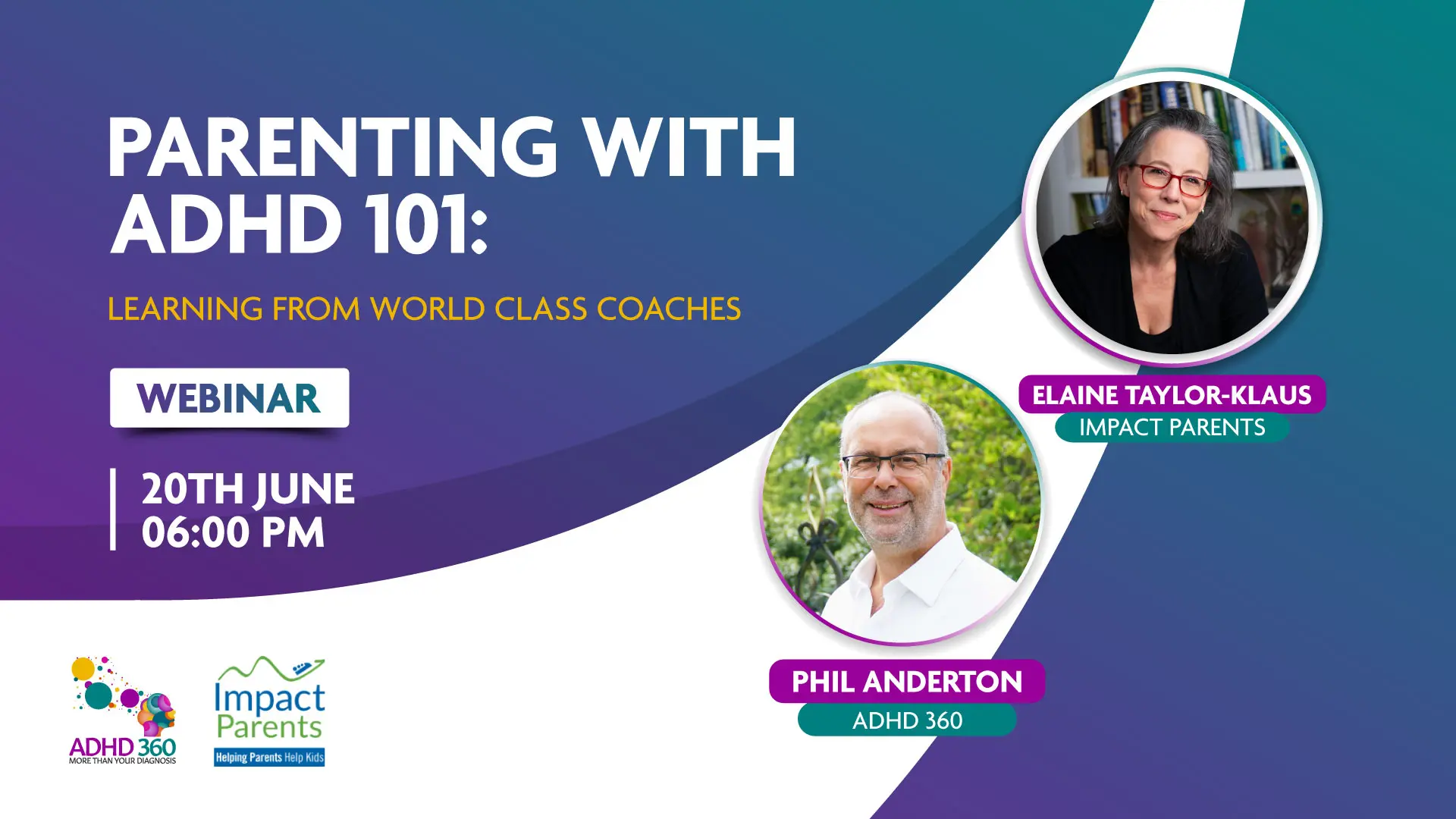
Parenting with ADHD 101: Learning from world class coaches
Navigating the challenges of parenting a child with ADHD can be overwhelming.
View our Webinar Replay, where Phil Anderton and world class coach Elaine shares her expertise and strategies to help you and your child thrive.
Learn practical tips, proven techniques and supportive approaches from experts who understand the uniques dynamics of ADHD.
ADHD360 mobile & desktop App
Keep yourself and your clinical team up to date with your ADHD symptoms and includes many useful tools.

Key Takeaways
- ✓ Neurological, Not Naughty: Reframe challenging ADHD behaviors as executive function and neurological differences rather than intentional misbehavior, eliminating shame, stigma, and judgment.
- ✓ Parent-Led Mindset Shift: Sustainable change begins with parental self-awareness and relationship dynamics—focusing on “wanting for your child rather than from them”—rather than enforcing rigid strategies or focusing solely on task outcomes.
- ✓ Proactive Emotional Regulation & Energy Management: Children with ADHD operate near their emotional threshold (“alert to alarm”) due to all-day cognitive strain; prioritizing emotional grounding before tackling academic or household tasks prevents burnout and conflict.
- ✓ Empowerment Through Coaching Methodologies: Equip parents and neurodivergent youth with adaptable problem-solving frameworks (“learning how to plan the fishing trip”) rather than temporary fixes, fostering lifelong self-advocacy and trust.
- ✓ Addressing Secondary Anxiety & Root Causes: Unmanaged executive dysfunction frequently manifests as secondary anxiety or protective behaviors like conflict-avoidant lying; identifying underlying motivations and modeling help-seeking behavior restores parent-child trust.
Webinar Transcript
Introduction and Background
Phil Anderton: Welcome everybody to Parenting with ADHD 101: Learning from World-Class Coaches. I am Phil Anderton from ADHD 360, and I am honored to be joined this evening by Elaine Taylor-Klaus. Elaine and I go back a long way in the world of ADHD. We first met many years ago at a CHADD conference. What is your recollection of our first meeting, Elaine?
Elaine Taylor-Klaus: When I first met you, you were extremely tall relative to me, so that made for an entertaining dynamic. At the time, you were training police officers, bringing a novel, preventive approach to ADHD management. We were both in a space of introducing new approaches, and that is where we clicked.
Phil Anderton: You later asked me to review your publication before it went to print, which was a delight. How would you describe your specialist area within ADHD?
Elaine Taylor-Klaus: There are two sides to that. From my personal expertise as a writer, speaker, and thinker, I translate the complexity of medical conditions like ADHD, autism, anxiety, and neurodiversity into accessible language that everyday humans can understand. My role is to demystify neurodiversity, helping parents and providers understand what it means to support neurodivergent individuals, release shame, stigma, and judgment, and enable kids to reach their potential.
Discovering the Coaching Mindset and Personal Diagnosis
Phil Anderton: I recall reading your work where you described being a mother to children with ADHD and how challenging the early years were. You experienced an epiphany that became a core coaching insight. Could you share that?
Elaine Taylor-Klaus: Discovering professional coaching was a major turning point because coaching offers an empowering framework. The biggest mindset shift was realizing my kids were not acting out on purpose. It was not naughty; it was neurological.
When my children were diagnosed one by one, I eventually got evaluated myself in my 40s and was diagnosed with learning and attention issues. The second major pivot was realizing I had struggled all my life with executive function challenges, often feeling unintelligent despite people telling me I was smart. I did not want my children or anyone else’s children to grow up carrying that negative self-narrative.
Phil Anderton: You highlight a common dynamic: parents with ADHD trying to manage children with ADHD without fully understanding their own neurology or their child’s.
Elaine Taylor-Klaus: To add to that complexity, I was married to a spouse whose ADHD was more pronounced, leaving me as the primary “executive function manager” in the home. Expecting myself to hold everything together while all of us were navigating unacknowledged neurodivergence was a massive challenge.
The ImpactParents Coaching Framework
Phil Anderton: What is the core foundation of the program you developed at ImpactParents?
Elaine Taylor-Klaus: We took principles from professional coaching and organizational change management and translated them into actionable parenting practices. Rather than providing rigid neurological frameworks or static strategies, we teach parents a problem-solving methodology.
If I give you ten strategies, they may or may not suit your child’s brain. But if I teach you a problem-solving framework, you can navigate any situation—whether it is a meltdown in a five-year-old, homework avoidance in a teenager, or a young adult struggling to launch. We want parents to possess a “Bring It On” attitude, equipped with a durable toolbox for whatever challenges arise.
Phil Anderton: I reviewed your book recently and noted how accurately it captures the realities of raising complex kids across ADHD, anxiety, and related conditions.
Universal Application of Neurodiversity Support
Phil Anderton: Given that you are based in the United States, does this parenting framework translate across the Atlantic to families in the UK and globally?
Elaine Taylor-Klaus: Absolutely. We work with many families across the UK and internationally. The fundamental principle is that the change you want for your children starts with you. As parents, we bring our own history, expectations, and conditioning into the relationship.
Our role is not to sculpt children into who we think they should be, but rather like Michelangelo’s unfinished sculptures, to unearth and allow the child to emerge as the best version of themselves. That requires managing our own mindset, expectations, and reactions—a universal parenting challenge regardless of geography or education system.
Navigating Co-Occurring Conditions and Secondary Anxiety
Phil Anderton: You emphasize anxiety prominently in your work. When an individual struggles to understand their neurodivergence, traditional management models can inadvertently heighten anxiety rather than relieve it. How do you address anxiety within your framework?
Elaine Taylor-Klaus: Girls with ADHD are frequently misdiagnosed with anxiety alone because societal expectations push them to internalize struggles, perform, and please others. Furthermore, for any gender, when you repeatedly experience an inability to meet environmental or self-imposed expectations, chronic stress and anxiety inevitably follow. Left unmanaged, this can lead to depression.
While primary anxiety can co-exist with ADHD, untreated ADHD often drives secondary anxiety. When individuals learn to manage their ADHD executive function challenges, secondary anxiety typically decreases. In addition, modern environmental stressors—such as constant digital connectivity and information overload—further strain neurodivergent nervous systems.
Task Initiation, Exam Pressure, and Supporting Teenagers
Phil Anderton: Dr. Thomas E. Brown describes executive dysfunction in task initiation as “erectile dysfunction of the mind”—wanting to start a task but being unable to trigger initiation. How can parents handle high-pressure situations, such as revision and exam preparation, without generating severe friction?
Elaine Taylor-Klaus: In high-stakes academic environments, parent-child communication and relationship dynamics become paramount. When stress rises, relationships can become strained or reactive. Parents often need to slow down to speed up.
Parents must shift from “wanting FROM” their child (expecting specific performance or metrics) to “wanting FOR” their child (offering genuine support). Assuming your child wants to succeed but is struggling gives you an entry point to join their team. Reassuring them, asking how you can support them, and reducing fear prevents escalation and preserves academic engagement.
Emotional Regulation and the “Alert to Alarm” Threshold
Phil Anderton: At ADHD 360, we refer to the emotional threshold as the “lose-it line.” Many neurodivergent individuals navigate daily life close to their capacity limit. An eruption that appears to go from 0 to 100 is often moving from 75 to 100.
Elaine Taylor-Klaus: Exactly. Children with ADHD spend their school day expending immense energy to maintain self-regulation, sustain focus, and suppress impulses. When they return home to a safe environment, they are often cognitively and emotionally exhausted.
Parents must distinguish between Task and Relationship. When a child is emotionally dysregulated, attempting to enforce a task (such as immediate homework or chores) will escalate the situation. Shift focus to emotional regulation first. Once the child is calm, return to the task collaboratively. Using inclusive language (“we”) and involving children in designing routines reduces defensiveness and builds long-term self-management skills.
Communication Strategies and Rebuilding Trust
Phil Anderton: How can parents rebuild trust with an ADHD teenager who frequently lies or avoids accountability?
Elaine Taylor-Klaus: In neurodivergent youth, lying is rarely driven by malice or manipulation. More often, it stems from conflict avoidance, fear of disappointing adults, executive overload, or shame from previous mistakes.
To rebuild trust, parents should examine what is driving the behavior. Are we unintentionally creating environments where telling the truth feels unsafe or overwhelming? Practicing Assume Best Intention (ABI) and avoiding accusatory starters (like “Why did you…” or “You always…”) reduces defensiveness. Focus on investing in the relationship outside of conflict areas to re-establish mutual trust.
Conclusion and Life Skills for Parents and Children
Phil Anderton: What closing guidance would you offer to parents navigating these challenges?
Elaine Taylor-Klaus: Give yourself credit for engaging and seeking answers. Parenting complex children is a marathon, not a sprint. The most valuable skill you can model for your child is the ability to ask for and accept help. Normalizing support for yourself demystifies help-seeking for your children, equipping them with a vital life skill.
Phil Anderton: Thank you, Elaine, for sharing your expertise and insights with our community.